OpenAI runs three bots, and they do three different jobs. GPTBot collects pages for training future models. OAI-SearchBot builds the index behind ChatGPT search. ChatGPT-User fetches a page live when someone asks ChatGPT a question that needs it. Each has its own robots.txt token. On getintel.ai they made 5,408 verified requests between 16 September and 15 October 2026, and 4,977 in the next 30 days, to 14 November.
GPTBot, the one most people block, made just 504 of them (9%) in the first month and 139 (3%) in the second, and in both months more than 90% of its requests came in a sweep of two or three days. OAI-SearchBot made 3,326 and then 3,377, and came on every one of the 60 days. ChatGPT-User made 1,578 and then 1,461, and never fewer than 26 in a day.
Disclosure: GetIntel sells AI visibility tracking, including AI crawler logs. These numbers come from one site, ours, over two consecutive 30-day windows, from DataFast's bot report. The daily counts per bot are downloadable as CSVs for the first month and the second. For every AI company's bots side by side, see our full AI crawler log.
In this article
- What do GPTBot, OAI-SearchBot and ChatGPT-User each do?
- Three bots, three daily rhythms
- GPTBot comes in short sweeps
- OAI-SearchBot crawls every day
- ChatGPT-User follows people, not a schedule
- Do the three bots read the same pages?
- The GPTBot and OAI-SearchBot robots.txt rules
- Which OpenAI bots should a B2B site allow?
- Limits of two months of OpenAI logs
What do GPTBot, OAI-SearchBot and ChatGPT-User each do?
GPTBot trains future models, OAI-SearchBot builds ChatGPT's search index, and ChatGPT-User reads a page live for a user's question. Blocking one leaves the other two untouched.
| Bot | User agent token | Job | 16 Sep to 15 Oct | 16 Oct to 14 Nov |
|---|---|---|---|---|
| GPTBot | GPTBot | Collects pages to train future models | 504 (9%) | 139 (3%) |
| OAI-SearchBot | OAI-SearchBot | Builds the ChatGPT search index | 3,326 (62%) | 3,377 (68%) |
| ChatGPT-User | ChatGPT-User | Fetches a page live for a user's question | 1,578 (29%) | 1,461 (29%) |
Requests to getintel.ai per 30-day window, with each bot's share of OpenAI's total.
OpenAI was the busiest AI company on our site in both months: 5,408 of the 17,599 verified bot requests in the first, and 4,977 of 16,079 in the second, 31% each time. OAI-SearchBot alone made 1.7 times as many requests as Googlebot in both windows (3,377 to 1,965 in the second). Only PerplexityBot, with 3,661 in the second month, made more requests as a single crawler.
The split matters because people usually talk about "blocking GPTBot" as if it were OpenAI's crawler. On our site it was the smallest of the three by a wide margin. The bot that decides whether you show up in ChatGPT search is OAI-SearchBot, and the one that reads your page while a buyer waits is ChatGPT-User.
Three bots, three daily rhythms
GPTBot came in two bursts, OAI-SearchBot crawled every day and got busier through the month, and ChatGPT-User held steady between 26 and 92 requests a day, 16 September to 15 October 2026.
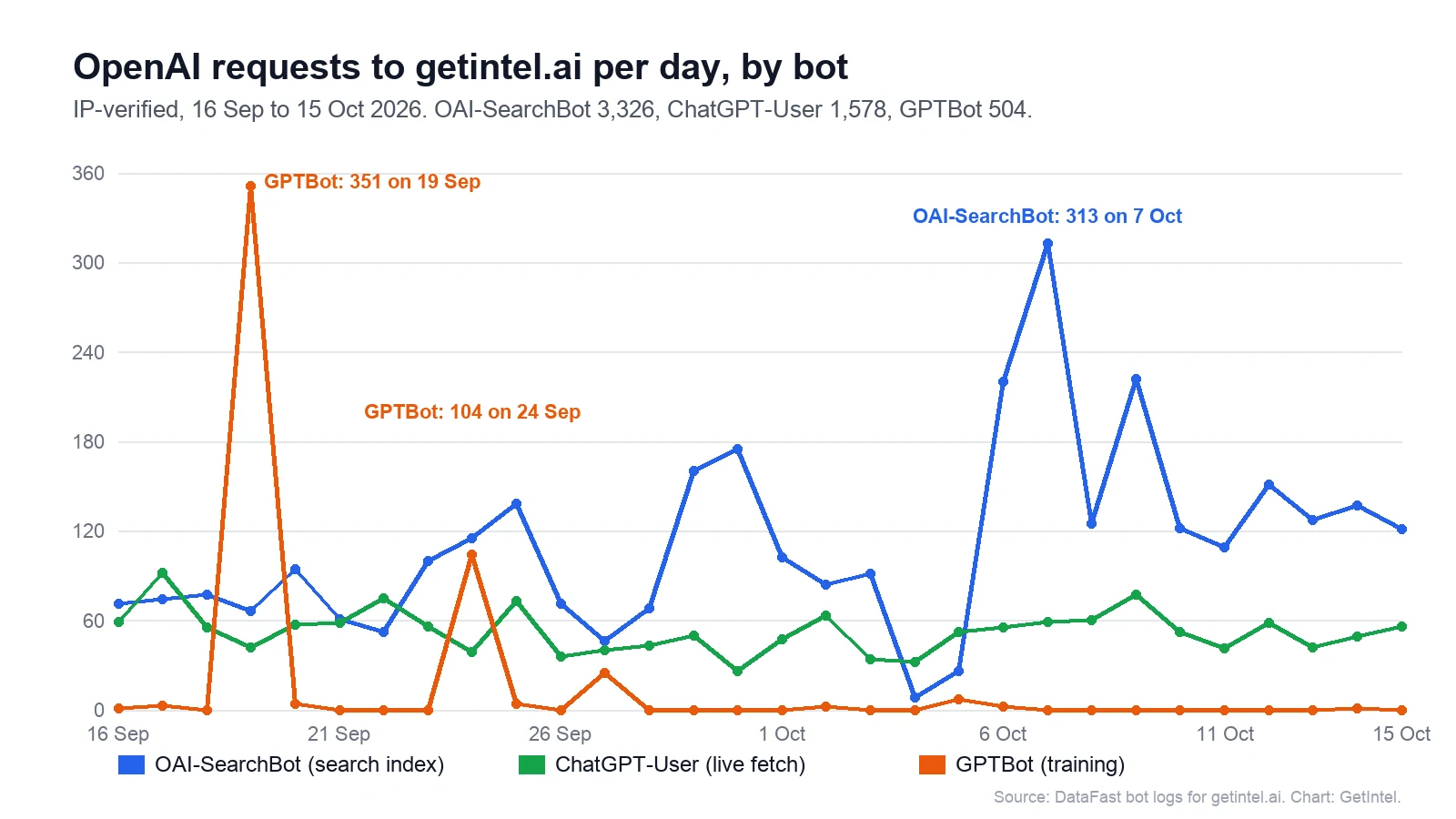
Daily requests by OpenAI bot, days in IST. Chart by GetIntel from DataFast bot logs for getintel.ai, October 2026.
| Bot | Busiest day | Quietest day | Days with zero requests |
|---|---|---|---|
| GPTBot | 351 (19 Sep) | 0 | 19 of 30 |
| OAI-SearchBot | 313 (7 Oct) | 8 (4 Oct) | 0 |
| ChatGPT-User | 92 (17 Sep) | 26 (30 Sep) | 0 |
The second month kept the same three shapes. GPTBot swept once, OAI-SearchBot crawled every day with one deep dip and one spike two days apart, and ChatGPT-User stayed between 33 and 77 a day.
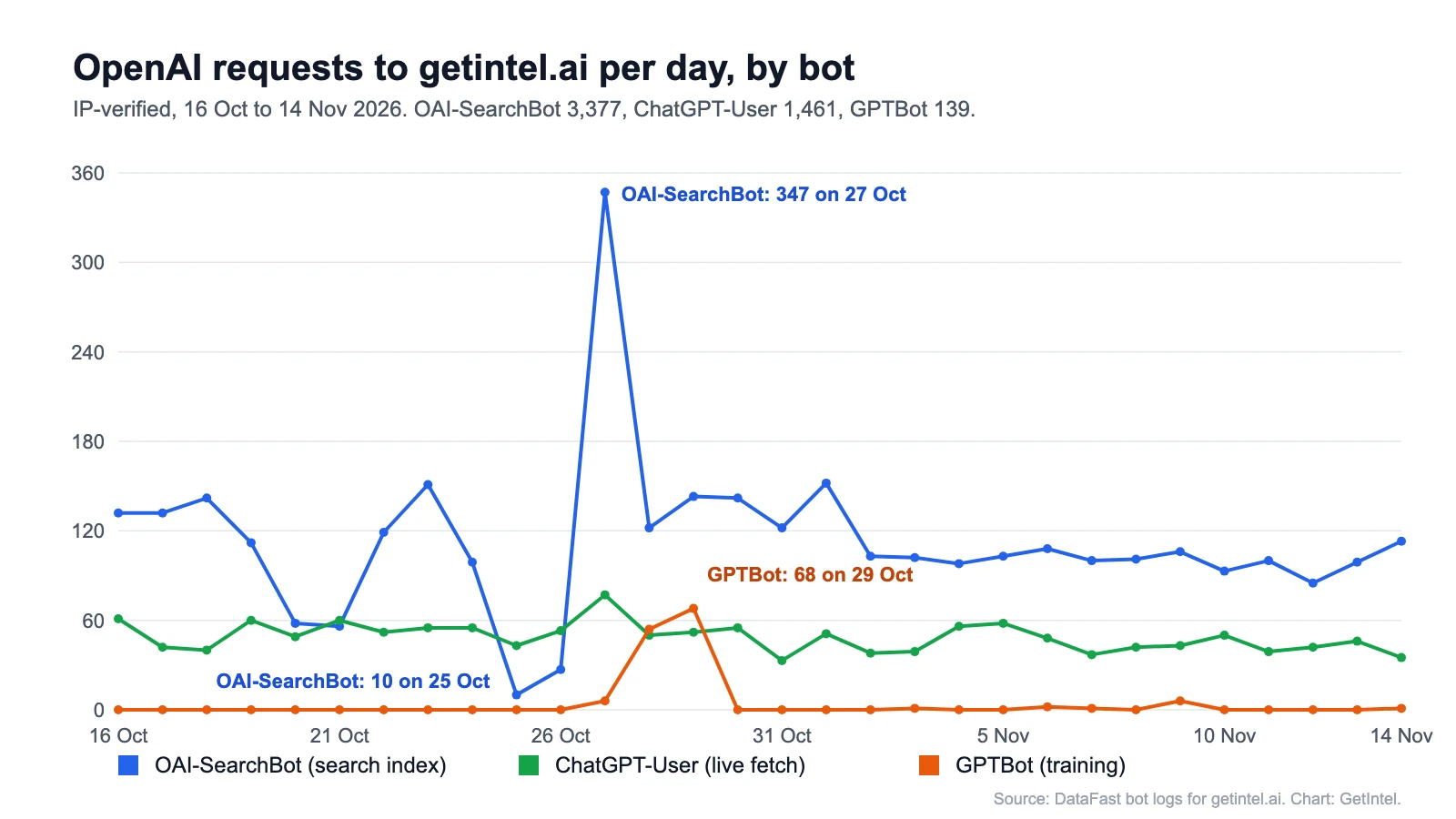
Daily requests by OpenAI bot, second month, days in IST. Chart by GetIntel from DataFast bot logs for getintel.ai, November 2026.
| Bot, 16 Oct to 14 Nov | Busiest day | Quietest day | Days with zero requests |
|---|---|---|---|
| GPTBot | 68 (29 Oct) | 0 | 22 of 30 |
| OAI-SearchBot | 347 (27 Oct) | 10 (25 Oct) | 0 |
| ChatGPT-User | 77 (27 Oct) | 33 (31 Oct) | 0 |
GPTBot comes in short sweeps
GPTBot made 351 requests on 19 September and 104 on 24 September. Those two days carried 455 of its 504 requests (90%). It made no requests at all on 19 of the 30 days.
On 7 of the other 9 days it came, it made fewer than five. Across the month it read each page about once: 504 requests across 433 URLs.
Half of what it read was our docs, and a quarter of its page requests (118) were the raw .md versions of our docs pages, the plain-text copies we publish for machines. ChatGPT-User didn't ask for a single .md file all month.
ClaudeBot swept the same week, on 20 and 22 September (our ClaudeBot breakdown). If GPTBot looks heavy in your logs one day and absent the next, that's the normal pattern, not a change in policy.
The second month repeated it. GPTBot made 128 of its 139 requests (92%) between 27 and 29 October, 33 days after the 24 September pass, and none at all on 22 of the 30 days. It was a lighter pass: 135 distinct URLs, never more than two requests each. Blog posts led this time (58 requests) ahead of docs (37), and only 14 requests were .md files.
OAI-SearchBot crawls every day
OAI-SearchBot showed up on all 30 days. It made 1,368 requests in the first 15 days and 1,958 in the last 15, a 43% rise. 6 to 9 October drew 880 requests, and three of those days (6, 7 and 9 October) were its busiest of the month.
That run started the day we re-checked and republished our SaaS directories list and pushed several other updates. We can't prove the link from one site's logs, but it fits how an index bot should behave: when pages change, it comes back to read them.
It also comes back to pages it already knows. It reached 697 distinct URLs and came back to each four to five times, and it re-read the homepage 363 times in the month. Its other top pages were our tool roundups, guides and pricing pages, the ones ChatGPT search would quote when someone asks which tool to buy.
In the second month the volume held (3,377 requests, within 2% of the first) but the list narrowed. It reached about 180 distinct URLs, well under half the first month's count, and came back to each about 19 times. The homepage took 512 requests. Next came two tool roundups, best AI citation tracking tools (95) and best GEO tools (92), and pages from our AI Software Index took 39% of everything it read. Its quietest day was 25 October, with 10 requests. Two days later it made 347, its busiest day of the month.
One cost of a crawler that remembers everything: OAI-SearchBot logged more 404 errors than any other bot, mostly old docs URLs we had already fixed. Our crawler log covers that quirk and the redirect fix. In the second month it logged none: 3,370 of its 3,377 requests returned a page and the other seven were redirects.
ChatGPT-User follows people, not a schedule
ChatGPT-User made between 26 and 92 requests every day, about 53 on average. Its four full weeks totalled 438, 337, 309 and 389. It didn't spike when we published and it didn't sweep. That's what you'd expect from a bot that only fires when a person asks ChatGPT something.
What it fetches tells you what those people asked. 53% of its requests were our homepage (838 fetches). Three of the next five were competitor pricing pages:
| Page | ChatGPT-User fetches |
|---|---|
| Peec AI pricing | 70 |
| Best SaaS directories | 63 |
| Semrush AI Visibility Toolkit pricing | 37 |
| Profound pricing | 32 |
| AI search statistics | 30 |
Pricing pages on this site took 266 fetches in all, 17% of everything it loaded.
The second month looked the same from outside: 1,461 fetches, never fewer than 33 a day. The homepage share grew to 70% (1,020 fetches). After it came the SaaS directories list (45), AI search statistics (32) and this article (24). Pricing pages fell to about 90 fetches, 6% of the total. Live fetches like this only happen inside the real chatgpt.com, which is one reason the API and the real ChatGPT interface cite such different sources.
Do the three bots read the same pages?
Mostly not. Across the 771 distinct pages any OpenAI bot touched in the month:
- 101 pages were read by all three.
- 250 pages were read only by OAI-SearchBot.
- 34 pages were read only by GPTBot, mostly docs.
- 40 of the 199 pages ChatGPT-User fetched were never crawled by OAI-SearchBot in that month.
That last line matters most. Two of ChatGPT-User's five most-fetched pages, the Profound and Semrush pricing posts, had no OAI-SearchBot visit in the window. A live fetch doesn't need the search bot to have been there first. ChatGPT can find a URL somewhere else and load it for the user directly.
The second month split them further. Of the 354 distinct pages any OpenAI bot touched, only 2 were read by all three, and 63 of the 117 pages ChatGPT-User fetched had no OAI-SearchBot visit in that window, including our own pricing page and the Semrush and Peec AI pricing posts.
So the three tokens are not three views of one crawl. Each bot keeps its own list, and blocking one leaves a gap the others don't fill.
The GPTBot and OAI-SearchBot robots.txt rules
The three tokens are independent, so you can opt out of training without leaving ChatGPT search. To keep search and live fetches but stop training, block GPTBot only:
User-agent: GPTBot
Disallow: /

User-agent: OAI-SearchBot
Allow: /

User-agent: ChatGPT-User
Allow: /
To block all three, give each its own group with Disallow: /. A User-agent: * block catches them too, but naming each bot is clearer and survives a later edit to the wildcard group.
Two things to know before you change the file:
- OpenAI says robots.txt changes take about a day to reach its systems for OAI-SearchBot.
- ChatGPT-User is the grey one. OpenAI's crawler docs say that because a user starts the fetch, robots.txt rules may not apply to it the way they do to the crawlers. If you need ChatGPT not to load a page at all, that's a job for authentication or your firewall, not robots.txt.
Which OpenAI bots should a B2B site allow?
Allow OAI-SearchBot and ChatGPT-User. Blocking OAI-SearchBot takes you out of ChatGPT search answers. Blocking ChatGPT-User may stop ChatGPT reading your homepage and pricing page when a buyer asks about you, though OpenAI says robots.txt may not apply to it. On our site those two made 91% of OpenAI's requests in the first month and 97% in the second.
Blocking GPTBot only decides whether future OpenAI models learn from your pages. On our site it was a light visitor either way: about 17 requests a day on average in the first month and under 5 in the second, almost all of them in sweeps. The wider case for and against blocking training bots is in our full crawler log.
If you want to see these bots on your own site rather than ours, GetIntel's AI traffic view logs every verified AI crawler and live fetch by page, on every plan.
Limits of two months of OpenAI logs
- One docs-heavy site, two months. A news site or a store will see different pages fetched and probably a different mix of bots.
- Three sweeps is not a schedule. GPTBot's passes came on 19 and 24 September and 27 to 29 October. That is a pattern for these 60 days, and the next could come in a week or in three months.
- The page counts come from a page-level match. Totals and daily counts are in the CSV; the per-page figures (homepage fetches, overlaps, URL counts) come from the 98% of requests DataFast matched to a URL.
- Fetches are not citations. A ChatGPT-User fetch means ChatGPT read the page for someone. It doesn't tell you whether the answer named you.