For B2B SaaS, the choice splits on measurement versus execution. GetIntel tracks ChatGPT, Perplexity, Gemini and Google AI Overviews daily from $29 a month and turns each gap into a ranked task. Semrush fits an existing SEO stack, SISTRIX is strongest on Google AI Overview citation data, and seoClarity, BrightEdge and Conductor are enterprise-priced. The fifteen tools below are ranked in two groups, the six built for AI visibility and the nine SEO suites that added it, with the reasoning for each.
Most advice about AI visibility tools for B2B SaaS companies starts in the wrong place. It treats visibility as a stream of generic brand mentions, even though buyers ask sharper questions: What does this product cost? What are the alternatives? Which tool integrates with our stack? What's the best platform for this category?
Disclosure: GetIntel sells an AI visibility tool and is listed first here. We counted this pattern across the category and found almost every vendor roundup does it, this one included. The competitor figures below are read from their own pricing pages and dated.
Those prompts expose the commercial gap between appearing somewhere in an answer and being recommended as a credible option. Google's AI Overviews appeared in 6.49% of queries in January 2025, rose to 24.61% in July, and settled at 15.69% by November in one longitudinal study, with coverage reaching about 16% of queries overall (Semrush's AI Overviews study). That volatility makes occasional audits inadequate for teams competing on high-intent searches.
A useful comparison therefore needs more than a feature checklist. It should examine findability measurement, citation capture, multi-engine coverage, competitor benchmarking, exports, integrations, and the path from diagnosis to shipped fixes. It should also separate platforms that monitor several answer engines from tools built mainly around Google AI Overviews.
The wider strategic case for focusing on the questions prospects ask is also reflected in Prometheus Agency's insights on increasing AI search visibility.
This list uses GetIntel as the reference point for buyer-prompt monitoring and coding-agent delivery.
Table of Contents
Dedicated AI visibility platforms
SEO suites that added AI visibility tracking
- 7. Semrush
- 8. SISTRIX
- 9. seoClarity
- 10. BrightEdge
- 11. Conductor
- 12. Similarweb Rank Tracker
- 13. STAT Search Analytics
- 14. Ahrefs
- 15. SE Ranking
- All 15 AI Visibility Tools for B2B SaaS, Comparison
- Choose the Tool That Matches Your Buyer-Intent Workflow
Dedicated AI visibility platforms
These six were built to measure what AI answers say. Ordered as GetIntel's own list, which puts GetIntel first.
1. GetIntel
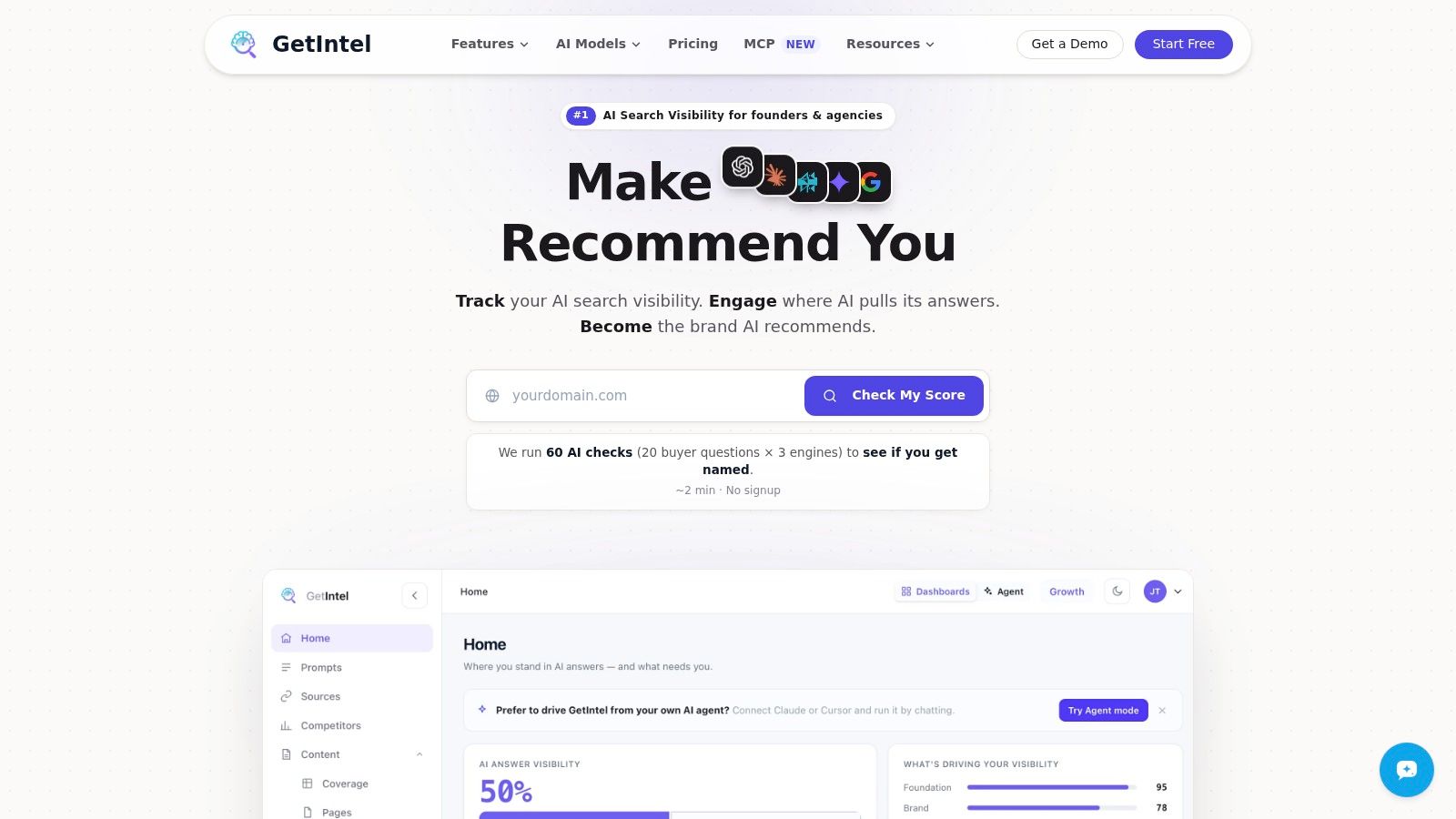
GetIntel fits B2B SaaS teams that need to measure whether AI engines recommend their product during evaluation. Its reporting goes beyond domain visibility, tracking ChatGPT, Perplexity, Gemini and Google AI Overviews daily, plus Claude weekly on the Growth plan, through topic-level scoring, Share of Voice, and Average Citation Rank captured from live interfaces rather than sanitized API outputs.
The platform organizes monitoring around buyer prompts, including pricing, “alternatives to” searches, integrations, and best-of-category comparisons. Its probe system runs about 60 checks, 20 buyer questions across three engines, then compares your citation share with the competitors those engines cite. This exposes a commercial gap that ordinary keyword tracking can miss. A SaaS company may rank for an informational query yet remain absent when a prospect asks which vendors belong on a shortlist.
From diagnosis to shipped work
GetIntel's clearest differentiator is its action layer. It identifies missing citations and turns them into a ranked task list across on-page, off-page, UGC and technical work, writing the pieces it can: the text blocks to add to a page, the outreach pitch, and the Reddit reply, with briefs for new pages. Teams can hand the task list to Claude Code or Cursor through MCP.
The platform also tracks Reddit threads and logs every source each AI engine cites. That source coverage matters because one 2026 analysis found that 64% of citations came from Wikipedia, Reddit threads, and primary-research domains, while brand-owned blogs represented 11% (Win With SEO's AI search analysis). For a SaaS team, the finding changes the recommended fix. Improving external evidence may matter more than publishing another product page.
Practical rule: Track the cited competitor and cited source together. The competitor shows who wins the answer. The source shows what evidence your team must create or influence.
Integrations, and the honest tradeoff
GetIntel's integrations, and the tradeoff they imply, start with Google Search Console, Cloudflare, Looker Studio, Slack, Zapier, webhooks, and an MCP server for coding agents. Agencies get per-client pricing and a separate brand per client. Plans scale by tracked buyer questions, see the comparison table for current tiers. A demo or score check takes about 2 minutes.
The tradeoff is implementation effort. Working the full task list, from the page copy it writes to the pitches and technical fixes, requires a developer, coding agent, or CMS connection. That suits developer-led SaaS companies, while a marketing team seeking a standalone dashboard may prefer a lower-setup alternative.
2. Profound
Profound is the best-funded platform in this category, having raised a $180M Series D announced on its own site. It is also the hardest to buy: it published Starter at $99/month and Growth at $399/month for part of 2026 and has withdrawn both, so its pricing page on 23 September 2026 showed only a free trial and a custom Enterprise plan, with the sole dollar figure on the page being a $180M Series D. The trial runs 50 prompts daily for 7 days across ChatGPT, Gemini and Google AI Overviews.
Its Enterprise tier reaches up to nine answer engines, well beyond the big-four default, including Copilot, Grok, DeepSeek and Google AI Mode. Its citation tooling sorts every cited URL into six categories (Owned, Competitor, Earned Media, PR Wire, Social, Institution) plus a custom one,.
Choose Profound when you need engine coverage beyond the big four, you are buying through procurement, and a sales cycle is acceptable. Skip it when you need a price you can put on a card this week. The fuller breakdown is in GetIntel vs Profound.
3. Peec AI
Peec AI sells $95 Starter for 50 prompts, $245 Pro for 150, $495 Advanced for 350, and a custom Enterprise tier, read from its pricing page on 17 September 2026. The detail that decides fit is engine selection: Peec gives you three models chosen from a pool of six, so ChatGPT, Perplexity, Gemini, AI Overviews, AI Mode and Copilot compete for three slots, with a fourth model available as an add-on at $30, $70 or $140 a month by tier.
Choose Peec when you want strong reporting and you know which three engines matter to you. Peec is widely described as offering unlimited seats, including elsewhere on this site until 24 September 2026. Read that day, its pricing page lists "Team users" as a feature with no number attached to any tier, so the claim is neither confirmed nor contradicted by Peec and is not a reason to pick it. Skip it when you need breadth across every surface at the entry price.
4. Otterly.AI
Otterly.AI starts at $29/month for Lite with 15 prompts, then $189 Standard for 100 and $489 Premium for 400, read on 23 September 2026. Its four base engines are ChatGPT, Google AI Overviews, Perplexity and Microsoft Copilot on every tier, with Claude, Gemini and Google AI Mode sold as paid add-ons rather than included.
Otterly.AI tracks across 50+ countries and runs brand sentiment analysis rather than only presence. It also ships an MCP server with a Claude Skill, API access on Standard and above, and workspace management for running client brands in isolation.
Choose Otterly when you sell into several markets or need more than 120 tracked prompts. Skip it when Gemini matters to you at the entry price, since it is an add-on there. The fuller breakdown is in GetIntel vs Otterly.AI.
5. Scrunch AI
Scrunch AI has no cheap tier: Core is $250/month, read from its pricing page on 23 September 2026, and buys 125 unique prompts, 5 site audits a month, 1 brand workspace, 5 user licences and four LLMs (ChatGPT, Perplexity, Google AI Overviews and Copilot). Above that is a custom Enterprise tier adding API access, SSO, expanded model coverage and its Agent Experience Platform.
Choose Scrunch when site auditing matters as much as prompt tracking and the $250 floor is not a constraint. Skip it when you want to start small, since there is nothing below Core.
6. AthenaHQ
AthenaHQ runs on credits rather than a prompt allowance. There is a free tier carrying $25 of credit and 300 credits across ChatGPT, Perplexity, AI Overviews, Gemini and Copilot, and a Starter plan at $295/month with 3,600 credits and visibility across 11 models including Claude, Grok, DeepSeek, Meta AI and Mistral. Read from its pricing page on 23 September 2026.
Eleven models is the widest published model list in this comparison, wider than Profound's nine, though credits rather than prompts means the volume you actually get depends on how often you run.
Choose AthenaHQ when model breadth is the requirement and you can model your usage against a credit balance. Skip it when you want a predictable prompt count for a predictable price.
SEO suites that added AI visibility tracking
These nine are established SEO, rank-tracking or content platforms that have added AI-answer tracking to an existing product. They are not worse, they are a different purchase: you are buying the SEO suite and getting AI visibility alongside it.
7. Semrush
Semrush suits B2B SaaS teams that already use a broad SEO and marketing intelligence stack. Its AI visibility reporting connects Google AI Overviews with wider LLM monitoring, competitor comparisons, Organic Research, Position Tracking, and scheduled reporting.
For a SaaS marketer, the important workflow is query-led. Position Tracking can flag target keywords that trigger AI Overviews and show whether a domain appears in the result. That lets a team compare a commercial category query with its conventional organic position, then investigate whether the brand is cited in the generated answer.
Where Semrush fits, and where it stops
Semrush is also practical for agencies because reporting and exports sit alongside established SEO workflows. Teams that need one environment for keyword research, competitive research, traditional rankings, and emerging AI visibility may prefer that breadth to a specialist platform.
The limitation is focus. Semrush's AI features are generally associated with higher-tier access, and its LLM metrics and coverage continue to evolve. It's better suited to a team consolidating marketing operations than to a lean product marketer who wants a tightly scoped daily view of pricing, alternatives, and integration prompts.
For a detailed feature-level comparison with GetIntel, see GetIntel vs Semrush. Semrush's usefulness is greatest when AI visibility needs to be interpreted beside organic search, market intelligence, and scheduled client reporting. It's less compelling if citation capture and engineering handoff are the central requirements.
The distinction between answer-engine visibility and classic SEO is also important in Big Moves Marketing's analysis of Semrush's AI search learnings.
8. SISTRIX
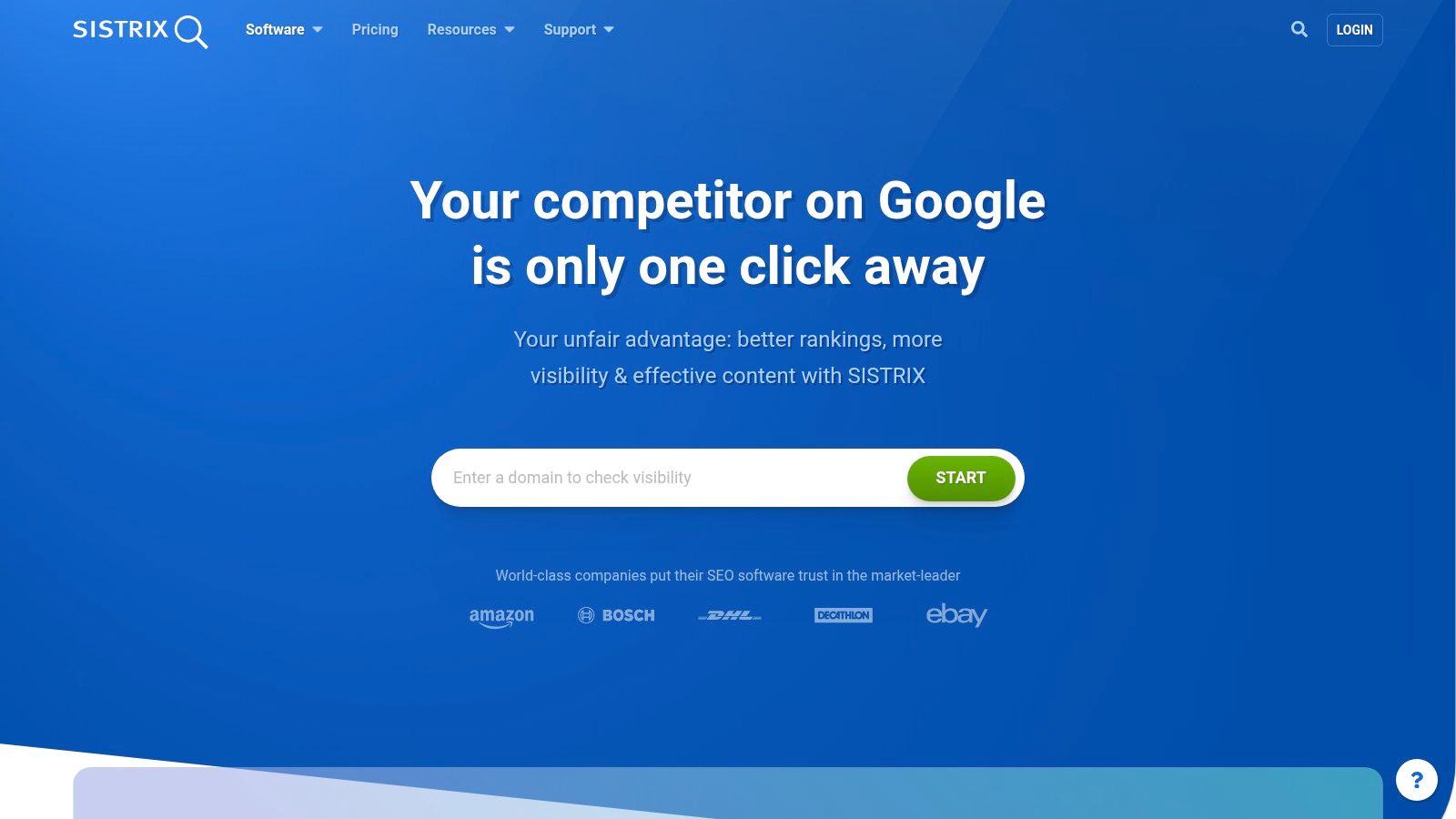
SISTRIX is a sensible option for teams that want strong Google AI Overview intelligence with an expanding prompt-monitoring layer. Its AI Overview capabilities identify when the feature appears, which domains it cites, and how those citations change over time.
That makes SISTRIX useful for a B2B SaaS company investigating source gaps. If a competitor repeatedly appears in an answer for a category comparison, the team can inspect the cited domains and distinguish a content problem from an authority or entity problem. The platform's Prompt Tracker extends this analysis across ChatGPT, Perplexity, and Google AI Overviews, with coverage metrics for brand and competitor prompts.
Where it fits operationally
SISTRIX also offers API endpoints for AI tracking, which can feed internal dashboards and reporting systems. That's valuable for agencies or larger teams that already have a data warehouse and want to combine AI citations with country, market, and competitor analysis.
Its strongest orientation remains Google AI Overviews. Teams seeking a deep, uniform view across ChatGPT, Claude, Perplexity, Gemini, and Google may find the multi-engine layer less mature than a specialist platform. The interface is most comfortable for SEO practitioners who already think in terms of domains, SERP features, historical trendlines, and citation sources.
For buyer-intent monitoring, SISTRIX works best when the prompt set is deliberately narrow. Start with pricing, alternatives, and category prompts, then use citation counts to identify where competitors have evidence that your brand lacks. It's less suited to a workflow that expects the platform to produce ready-to-ship schema, entity, or outreach fixes.
9. seoClarity
seoClarity is built for enterprise SEO and answer-engine optimization teams that need measurement connected to technical execution. Its AI search tracking monitors AI-driven results and competitors, while schema, on-page optimization, testing, and internal-linking tools help teams act on findings.
That combination matters for larger B2B SaaS websites. A visibility report is only useful if someone can update the relevant page, test the change, and record whether the result improved. seoClarity's enterprise workflows are designed around that operating model rather than treating AI visibility as an isolated marketing report.
The advantage is execution depth
GetIntel's advantage is execution depth: teams can connect observed visibility issues with schema improvements, content changes, and internal-linking work. Its SEO Split Tester can support controlled evaluation of changes, while internal-linking tools help distribute authority across important comparison, integration, and alternative pages.
The downside is proportionality. seoClarity generally requires enterprise-level investment and implementation effort, so a small SaaS team with a narrow buyer-prompt set may pay for capabilities it won't use. It also requires coordination between SEO, content, engineering, and analytics teams.
For organizations managing multiple sites, large content libraries, or complicated approval processes, that depth can be an advantage. For a founder trying to answer a simpler question, such as “Why does ChatGPT recommend three competitors instead of us for this integration category?”, a more focused prompt and citation platform may produce insight faster.
10. BrightEdge
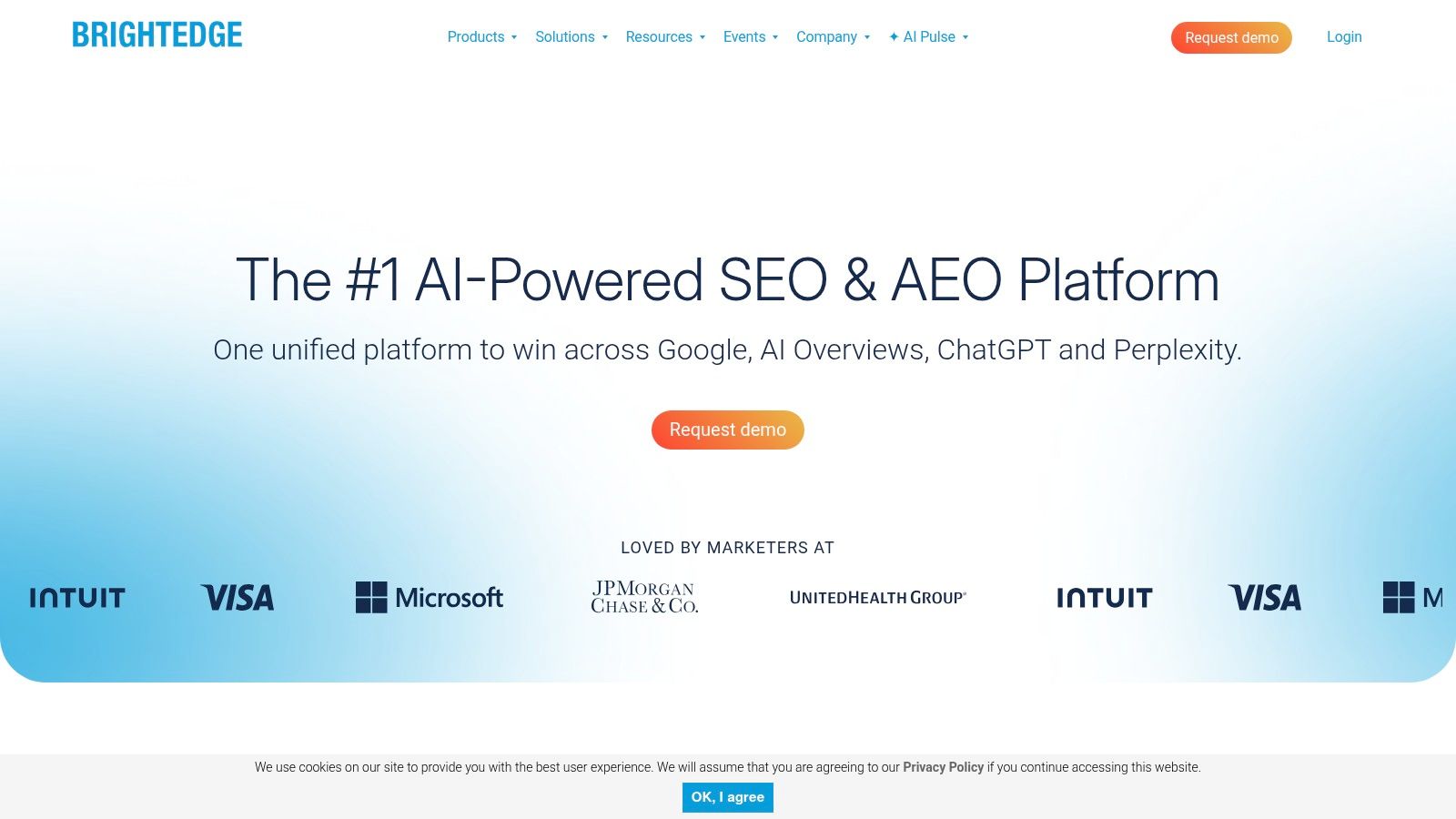
BrightEdge is a strong choice for large organizations focused on Google AI Overviews. Its research and product work around AI Overviews includes the Generative Parser and Data Cube X guidance, giving enterprise teams ways to detect exposure, monitor priority queries, and study source patterns.
The platform's value is change detection at scale. A large B2B SaaS brand can monitor where AI Overviews appear, examine which sources are used, and report shifts across priority keyword groups. That creates a useful bridge between traditional search governance and AI-generated result monitoring.
AIO depth versus buyer-prompt breadth
BrightEdge trades buyer-prompt breadth for AI Overview depth, and its main limitation is that Google-centric orientation. If your commercial problem is specifically exposure in Google AI Overviews, that focus is appropriate. If prospects use several conversational engines to compare pricing, alternatives, security, and integrations, you'll need to verify how much multi-LLM prompt detail the package provides.
The platform is also sold through enterprise contracts. That can work for organizations with established SEO operations, reporting requirements, and large keyword portfolios. It's less natural for an early-stage SaaS team that wants a quick baseline, a small prompt inventory, and a direct route to content or entity fixes.
BrightEdge makes the most sense when AI Overview monitoring must fit an existing enterprise SEO program. It's not the obvious first choice when the core success metric is daily recommendation share across multiple live answer engines.
11. Conductor
Conductor connects AI search performance with content workflows. Its reporting shows whether a brand appears in ChatGPT responses and Google AI Overviews, tracks Share of Voice against competitors, and links insights to content tools such as Writing Assistant.
That connection is useful for B2B SaaS teams where product marketing and content teams own the response. A prompt report can identify a missing presence for a category or alternative question, while the content workflow gives writers a place to develop the supporting material.
Conductor also distinguishes tracking modes that mirror the user experience from analysis views. That distinction should be part of any serious evaluation. A clean analytical dataset may help identify patterns, but buyers see rendered answers, citations, caveats, and competitor lists inside an interface.
A platform that can't show the answer a buyer saw leaves the most important part of the review process to memory.
Who Conductor is actually for
The product is enterprise-focused, and smaller teams may not use its full breadth. AI visibility is centered on leading LLMs and Google, with coverage evolving as the search environment changes. Teams should test their actual commercial prompts before treating the reported Share of Voice as a complete view.
Conductor is a good fit when the priority is an insight-to-content workflow inside a mature marketing organization. It's less differentiated for a developer-led team that wants MCP delivery into Claude Code or Cursor, plus a detailed audit trail connecting each shipped fix to movement in a multi-engine answer rate.
12. Similarweb Rank Tracker
Similarweb Rank Tracker is best understood as an enterprise rank-tracking system with AI Overview detection, not as a full multi-engine buyer-prompt platform. The Rank Ranger capabilities identify keywords that trigger AI Overviews and let teams filter SERP visibility, positions, estimated clicks, locations, devices, and tags.
That makes it useful for B2B SaaS organizations that already manage large keyword portfolios and want AIO signals inside an established rank-tracking process. A team can isolate commercial terms, compare locations, and feed results into dashboards through API access.
Useful for SERP governance
The tool's strength is structured search measurement. If the question is whether a particular pricing or comparison keyword produces an AI Overview and whether your page is cited, Similarweb can add that signal to a broader SERP report.
Its weakness is the boundary between a keyword and a conversational prompt. A buyer may ask an AI engine to recommend alternatives without using the exact phrase a rank tracker monitors. Similarweb's multi-LLM prompt visibility is limited compared with platforms designed to test rendered answers across conversational systems.
Some users have also reported migration or retention friction following the Rank Ranger acquisition. That doesn't determine product fit, but it does make workflow validation important for teams moving established reporting systems.
Choose Similarweb when Google rank tracking, API connectivity, and location depth dominate the requirement. Choose a specialist platform when the key question is which vendors appear in live answers for pricing, alternatives, integrations, and best-of prompts.
13. STAT Search Analytics
STAT Search Analytics is another enterprise-oriented option for teams that want AI Overview monitoring layered onto large-scale SERP intelligence. It tracks daily AIO presence and citations across monitored keywords, with multi-geo and multi-device capabilities that suit agencies and large organizations.
The familiar rank-tracking model can reduce adoption friction. SEO teams already working with STAT can add AI Overview presence and citation data without replacing their established keyword, reporting, and export workflows. Integrations with Google Search Console and GA4 can also help teams combine search visibility with broader performance reporting.
For B2B SaaS, the most useful application is a segmented commercial keyword set. Track pricing, comparison, integration, and alternatives terms separately from informational content, then review whether cited pages and domains change over time.
The limits of a rank-tracking model
STAT's AI measurement centres on Google SERPs, so multi-LLM tracking is not its core capability. STAT's AI measurement is centered on Google SERPs, and multi-LLM tracking isn't its core capability. That means it won't fully answer whether ChatGPT, Claude, Perplexity, or Gemini recommend your product when buyers ask open-ended category questions.
Pricing and access are also enterprise-leaning. Agencies with established client portfolios may value the scale, while lean SaaS teams may find a dedicated buyer-prompt tool easier to configure and more aligned with their immediate questions.
STAT is therefore a strong extension for an enterprise SEO program, not a substitute for cross-engine recommendation monitoring. Its value rises when your reporting starts with tracked keywords and Google results, then adds AIO citation context.
14. Ahrefs
Ahrefs is a practical choice for teams that already rely on it for links, content research, and competitive analysis. Its free AI Overviews Tracker and Brand Radar extend that existing workflow into AI visibility, while custom prompt tracking can help compare brand and competitor mentions.
For a B2B SaaS marketer, the benefit is consolidation. Link gaps, content opportunities, competitor research, and AI Overview changes can sit in one familiar environment. That's useful when the team's first priority is understanding whether existing SEO and authority work is influencing AI-generated results.
Where Ahrefs stops short
Ahrefs' research and reporting experience is a clear strength, but access to deeper AI visibility capabilities depends on the subscription tier. Its datasets also remain deeper for Google than for multi-LLM coverage, so teams shouldn't assume that a strong SEO dataset provides an equally complete view of conversational recommendations.
The distinction becomes important for high-intent prompts. A backlink report can show authority gaps, but it won't by itself explain why a model recommends one competitor for “best analytics platform” and another for “tools with Salesforce integration.” Custom prompt tracking helps, but teams should inspect answer capture, engine coverage, citation rank, and competitor source overlap before deciding that the measurement is sufficient.
For a detailed comparison with the specialist workflow described here, see GetIntel vs Ahrefs Brand Radar. Ahrefs is the better fit when AI visibility is an extension of a mature SEO program. GetIntel is more directly aligned when the team needs daily buyer-prompt probes, live answer capture, and fixes delivered through coding agents.
15. SE Ranking
SE Ranking offers a comparatively accessible route into AI Overview and broader AI visibility monitoring. It detects AI Overviews for tracked keywords, reports brand mentions and citations, compares competitors, and exposes API access for reporting workflows.
Its AI visibility layer extends across Google AI Overviews and AI Mode, ChatGPT, Gemini, and Perplexity. That breadth makes SE Ranking interesting for small and mid-sized SaaS teams that want more than Google-only monitoring without immediately adopting an enterprise platform.
The strongest use case is a team that wants classic SEO and AI signals in one place. A marketer can track rankings, inspect AI Overview presence, compare cited competitors, and connect the findings to an existing SEO program. Tutorials and API access can also shorten the path from initial setup to recurring reporting.
Validate the methodology on your prompts
SE Ranking's most mature coverage is Google-focused, while multi-LLM depth is newer. Its methodology and coverage can shift as AI Overviews and AI Mode evolve, so teams should test the exact commercial prompts they care about rather than relying on broad feature descriptions.
Use separate prompt groups for pricing, alternatives, integrations, security, implementation, and best-of comparisons. Industry guidance recommends a buyer-prompt inventory of 30 to 75 prompts across these categories (HyperMind GEO's B2B SaaS buyer-prompt guidance). That structure gives SE Ranking, or any shortlisted tool, a more useful test than a generic brand query.
SE Ranking is a good fit for lean teams that value price-to-capability balance, API access, and an existing SEO foundation. It's less suitable if you need deep live-interface capture, detailed citation-source intelligence across every major engine, or an integrated coding-agent workflow that turns findings into reviewable repository changes.
All 15 AI Visibility Tools for B2B SaaS, Comparison
The fifteen tools below are compared on coverage and fit rather than scored, and are grouped into the six built for AI visibility and the nine SEO platforms that added it. This table used to carry a quality score in stars and we removed it. GetIntel published this list, put itself first in it, and had awarded itself five stars while every competitor got four or fewer, which is a judgement dressed as data. The columns that remain are checkable. The ordering is still ours, and 16 of 17 vendor roundups rank themselves first, including this one.
| Product | Core capability | Value 💰 | Target audience 👥 | Unique selling point ✨ |
|---|---|---|---|---|
| GetIntel | Daily topic-level scoring, Share of Voice, Avg Citation Rank from live UI captures; buyer-prompt probes; ranked task list & integrations | 💰 $29–$149/mo · 7‑day trial | 👥 B2B SaaS growth teams & agencies | ✨ Multi-LLM live captures + competitor-aware scoring + ranked task-list workflow |
| Profound | Up to 9 answer engines at Enterprise; six-category citation and source classification | 💰💰💰 No published price; free trial or Enterprise only (23 Sep 2026) | 👥 Enterprise teams buying through procurement | ✨ Nine answer engines at Enterprise, including Copilot, Grok and DeepSeek |
| Peec AI | Prompt tracking with three models chosen from a pool of six | 💰💰 $95 / $245 / $495 (17 Sep 2026) | 👥 Teams that know which engines matter to them | ✨ Three engines tracked properly rather than six thinly |
| Otterly.AI | Four base engines incl. Copilot, 50+ countries, sentiment, MCP + Claude Skill | 💰 $29 / $189 / $489 (23 Sep 2026) | 👥 Multi-market brands and agencies | ✨ Geographic breadth and sentiment |
| Scrunch AI | 125 prompts, 5 site audits/mo, 4 LLMs, agent-experience platform at Enterprise | 💰💰💰 $250/mo floor (23 Sep 2026) | 👥 Teams pairing site audit with prompt tracking | ✨ Site auditing alongside visibility |
| AthenaHQ | Credit-based tracking across 11 models; free tier with 300 credits | 💰💰💰 Free, then $295/mo (23 Sep 2026) | 👥 Teams needing the widest model list | ✨ 11 models, more than anything else here |
| Semrush | Unified SEO + AI visibility (AIO & LLM benchmarking, position tracking, reporting) | 💰💰 Tiered; AI features on higher plans | 👥 Marketing teams & agencies wanting an all‑in‑one stack | ✨ Integrated SEO toolset + automated reporting |
| SISTRIX | AIO detection, domain citation counts, Prompt Tracker (ChatGPT, Perplexity, AIO) | 💰💰 Mid-range (strong EU coverage) | 👥 Brands and SEO teams, Europe focus | ✨ Clear AIO citation intelligence & country-level trends |
| seoClarity | Enterprise AEO suite: AI tracking, schema/on‑page optimizers, testing tools | 💰💰💰 Enterprise-priced | 👥 Enterprise SEO/AEO teams | ✨ Deep workflow from detection to on‑site testing & optimization |
| BrightEdge | Detects AIO exposure, Generative Parser, Data Cube X research & benchmarks | 💰💰💰 Enterprise contracts | 👥 Large brands & complex organizations | ✨ AIO research leadership + enterprise reporting at scale |
| Conductor | AI Search Performance + share‑of‑voice tracking tied to content workflows | 💰💰💰 Enterprise-focused | 👥 Content & SEO teams wanting insight→action | ✨ Built-in content execution hooks from AI diagnostics |
| Similarweb Rank Tracker (Rank Ranger) | Daily rank tracking with AIO detection, multi-location/device, API | 💰💰 Enterprise-grade | 👥 Large teams needing robust rank depth | ✨ Enterprise rank tracking + programmatic API access |
| STAT Search Analytics (Moz) | Large-scale rank tracking with AIO presence/citation monitoring & exports | 💰💰💰 Enterprise-leaning | 👥 Agencies & enterprises with big keyword sets | ✨ Scalable SERP intelligence for agency portfolios |
| Ahrefs | AI Overviews Tracker, Brand Radar, custom prompt tracking; complements link workflows | 💰💰 Mid-tier (some features on higher plans) | 👥 SEO & link/content teams | ✨ Strong research UX + practical AIO tools (some free) |
| SE Ranking | AIO & multi‑LLM tracking, brand mentions/citations, API access | 💰 Affordable · good price/capability | 👥 Small→mid teams & agencies | ✨ Cost-effective multi‑LLM coverage with API support |
Choose the Tool That Matches Your Buyer-Intent Workflow
The right tool depends less on how many dashboards it includes than on whether it can answer one operational question: which buyer prompts produce recommendations for us, which competitors appear instead, and what can our team ship next?
Start by assigning ownership. Growth may own the daily baseline and business impact. Product marketing may own pricing, alternatives, integrations, security, and best-of prompts. Engineering may own schema, llms.txt, repository changes, and CMS delivery. An agency may need multi-brand workspaces, exports, scheduled reports, and white-label presentation.
Your evaluation should cover these areas:
- Prompt ownership: Can the team define and maintain a controlled inventory of commercial questions rather than generic brand mentions?
- Commercial coverage: Does the platform test pricing, alternatives, integrations, and category comparisons separately?
- Capture method: Does it record live rendered answers, or does it rely mainly on API or SERP data?
- Core metrics: Can it report topic-level scores, Share of Voice, Average Citation Rank, citation presence, and per-prompt standings?
- Engine depth: Does it cover ChatGPT, Claude, Perplexity, Gemini, and Google AI Overviews, or mainly Google results?
- Competitor benchmarking: Does it compare you with the competitors cited by the engine?
- Source intelligence: Can it show whether citations come from your site, Reddit, X, G2, Wikipedia, Product Hunt, review sites, or research domains?
- Workflow delivery: Can findings become schema, entity, content, or outreach work that reaches the person who can ship it?
- Integrations and exports: Check Google Search Console, Ahrefs, Slack, Zapier, webhooks, API, CSV, and trend-history support.
- Agency reporting: Confirm multi-brand management, seat limits, client reporting, and white-label options if those matter.
- Implementation effort: Decide whether your team can configure the platform, connect a CMS, or use Claude Code or Cursor through MCP.
- Plan limits: Verify brand, prompt, engine, refresh, export, and user limits before comparing headline pricing.
The attribution blind spot
A traffic dashboard can create false confidence, because most teams cannot see AI-referred traffic at all. A 2026 B2B SaaS report found that 22% of marketers had no analytics setup for AI traffic, while 37% were unsure whether they could track it, and nearly six in ten respondents couldn't see AI-referred traffic in analytics (CommonMind's State of AI Visibility in B2B SaaS). A defensible program needs visibility metrics, cited-source records, prompt-level history, and a way to annotate shipped changes.
Why one engine is not enough
Citations barely overlap between engines, so a single-engine report misses most of the evidence. One benchmark found that only 2% of cited URLs appeared across AI Overviews, ChatGPT, and Perplexity simultaneously, while 91% of citations appeared in only one engine (CommonMind's benchmark coverage).
How to run the evaluation
Run the same buyer prompts through every shortlisted platform. Record the current recommendations, cited competitors, cited domains, answer wording, and whether the tool captures the live interface. Then connect the chosen workflow to the team that can act. Most vendors in this category now ship one: twelve of sixteen documented an MCP server when we checked which AI visibility tools connect to Claude Code, so the question is what the connection carries rather than whether it exists. MCP-based delivery is particularly relevant for engineering-led SaaS teams because documented Cursor integrations support MCP configuration through project or user configuration files, while reusable server prompts can support project-specific workflows (Conductor's MCP documentation).
A practical starting sequence
The evaluation runs as six steps, in order:
- Define the prompt set. Group pricing, alternatives, integrations, comparison, trust, security, and implementation questions.
- Record the baseline. Capture recommendations, cited competitors, cited sources, topic-level scores, Share of Voice, and Average Citation Rank where available.
- Assign the owner. Give each gap to growth, product marketing, engineering, or an agency partner.
- Connect the workflow. Use API, CSV, Slack, webhooks, CMS connections, or MCP delivery according to your team's existing tools.
- Run a focused improvement cycle. Prioritize the few content, entity, schema, community, review, research, or outreach changes most closely tied to missing citations.
- Review movement daily. Compare score and citation changes against the logged actions, while checking whether the same improvement appears across engines or only in one interface.
Why this is worth doing now
Buyer-side adoption is moving faster than measurement maturity. One 2026 summary reported that 73% of B2B buyers use AI tools during research, 50% start software buying in an AI chatbot, and 25% say AI has overtaken traditional search for vendor research, while only 22% of marketers track AI visibility (Ranqo's B2B SaaS AI visibility playbook). Those figures point to the selection criterion: choose the tool that helps your team prove recommendation presence, improve citation share, and ship the fix before a competitor owns the next shortlist.
If your team is still unsure whether the market is large enough to justify the work, Reuters reported in June 2026 that ChatGPT reached 1 billion global monthly active app users, based on Sensor Tower estimates (Reuters' report on ChatGPT adoption). The discovery surface is no longer a niche experiment. The operational question is whether your measurement reflects the prompts your buyers use and the evidence answer engines cite.
GetIntel measures daily topic-level scores, Share of Voice, and Average Citation Rank across major answer engines, then turns buyer-prompt gaps into a ranked task list across on-page, off-page, UGC, and technical fixes. Visit GetIntel to test your pricing, alternatives, integration, and best-of prompts, connect the workflow to Claude Code or Cursor, and establish a baseline your team can improve. The marketing-team version of the product is at GetIntel for marketing teams.