Low search volume is still treated as a permission slip to ignore AI visibility. That advice is outdated. In a specialized B2B category, buyers may ask only a small number of commercially meaningful questions, but those questions often arrive at the exact moment they're comparing vendors, checking technical fit, or validating a recommendation. If an answer engine cites a competitor and omits your company, your problem isn't a missing keyword ranking. It's a missing place in the buyer's shortlist.
The practical unit of analysis is no longer monthly query volume. It's the buyer question, the answer produced, and the citation ecosystem behind it. A single authoritative standards page, trade publication, directory listing, or clearly structured service page can matter more than a large library of thin articles. That's the operating model for AI visibility for niche low search volume industries.
Table of Contents
- Why Low Search Volume No Longer Means Low AI Stakes
- Citation concentration is the real signal
- Which Signals Actually Matter in a Niche?
- The four core signals
- Running Buyer-Prompt Probes and Capturing Live Answers
- A worked probe workflow
- Two common measurement failures
- Where Are Your Citation Gaps Against Named Competitors?
- Worked example in industrial vacuum metallurgy
- Which Fix Lever Suits Each Gap?
- Match the lever to the evidence
- Schema, Entities, and llms.txt in Thin-Footprint Niches
- What structured data can and cannot do
- Tracking Impact and Shipping the Next Round of Fixes
- A 30-60-90 day cadence
Why Low Search Volume No Longer Means Low AI Stakes
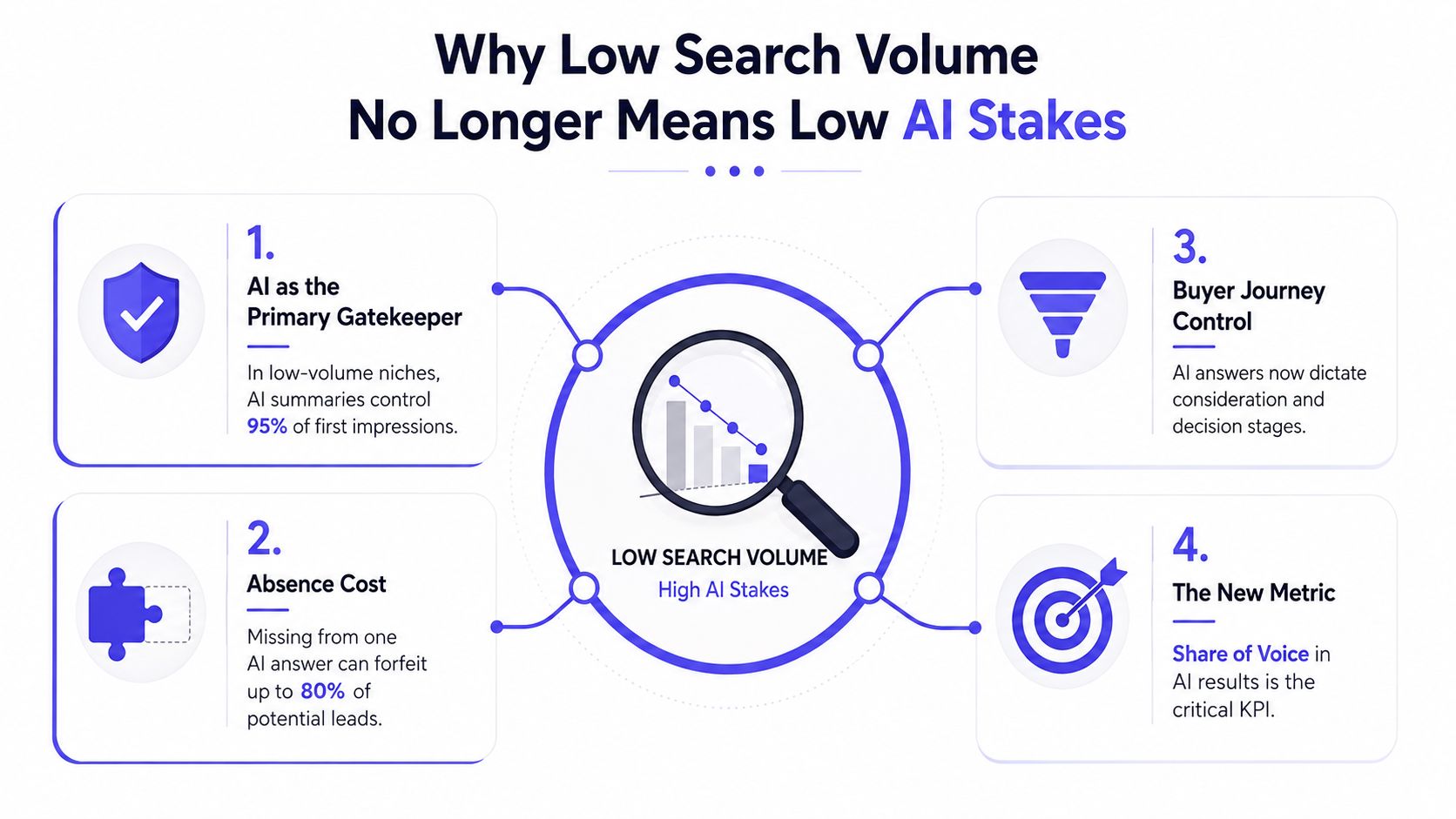
Reviewed 19 September 2026. Low search volume no longer means low AI stakes. The popular advice says to prioritise markets with enough search demand to justify content production. That makes sense for a traffic-led SEO program, but it breaks down when buyers use AI tools to compress research into a few answers. A procurement manager evaluating industrial cryogenic storage valve servicing isn't necessarily searching for dozens of related phrases. They may ask one detailed question about service capability, standards compliance, turnaround, or vendor suitability, then use the answer to shape the next conversation.
Answer engines turn that question into a shortlist. They summarize vendors, explain technical distinctions, and attach citations that make the response feel verifiable. The brand that earns inclusion in that summary can influence consideration even when the underlying category has little measurable keyword demand.
The stakes vary by category, but the principle is consistent. A small SaaS category with a modest monthly contract can be more strategically important than a crowded enterprise category with a larger deal size if the buyer journey is concentrated around a few high-intent prompts. Impression volume doesn't tell you how much decision-making power a citation carries.
Citation concentration is the real signal
Citation concentration is highly uneven by vertical. Some categories are dominated by a handful of repeatedly-cited brands; others show almost no measurable AI visibility at all, regardless of what a keyword-volume tool would predict for that market.
That unevenness doesn't prove every niche behaves identically. It does show why category specificity matters more than aggregate keyword demand: a market can be highly concentrated among a few cited brands, or it can be almost entirely unrepresented. In both cases, a traditional volume report hides the decision risk.
Citation coverage also changes quickly. US ChatGPT prompts with citations rose from about 1.6% in June 2025 to roughly 6.8% by May 2026, while Travel and Hospitality prompts carried citations about 23% of the time, Automotive around 20%, and Professional Services under 4%, according to Similarweb's own 2026 AI citation benchmark data. The lesson for a niche operator is straightforward: measure whether the important answers cite you, not whether a keyword tool estimates enough searches.
Practical rule: In a low-volume category, track the sources that answer engines trust before you scale the number of pages you publish.
If you need to expand the number of places where a specialized company can be discovered, a targeted directory submission push can be one part of a broader distribution plan. It shouldn't replace first-party evidence or credible third-party references, but it can help establish consistent category and entity signals where directory ecosystems influence discovery.
Which Signals Actually Matter in a Niche?
Four signals matter in a niche programme. A niche AI-visibility programme needs fewer metrics than a conventional SEO dashboard, but each metric must connect to a real buyer question. Rankings and estimated volume can remain useful as background context. They shouldn't determine which fixes receive priority.
Start with a fixed prompt set built from sales calls, support tickets, proposal objections, implementation questions, and competitor comparisons. Examples include:
- “Which companies service industrial cryogenic storage valves?”
- “What should a buyer check before selecting a bio-composite fastener supplier?”
- “Which vendors support the relevant ASTM specification?”
- “What are the alternatives to [competitor] for specialized financing?”
Then measure how each answer behaves.
The four core signals
Citation share measures the proportion of tracked answers that cite your brand or your owned sources. It tells you whether you're present, but not whether the answer frames you positively.
Source-of-truth strength evaluates whether your core entity pages clearly establish who you are, what you provide, where you operate, and which claims you can substantiate. A service page that names capabilities without identifying authorship, standards, geography, or evidence has weak interpretive value.
Answer appearance rate records how often your company appears in the response, whether as a recommendation, an alternative, a definition, or a cited source. A brand mentioned only in a long list has a different commercial position from one described as a direct fit.
Sentiment and framing capture the language around the citation. “Specialist in regulated installations” is materially different from “small provider with limited coverage.” Record the wording, not just the mention.
A useful composite measure is Citation Influence Rate. Define it internally as the share of priority prompts where your brand is both present and supported by a cited source, adjusted for answer position and competitor displacement. The exact formula matters less than consistency. Your team should be able to explain why the score moved and which shipped change caused it.
| Metric | What It Measures | Why It Matters in Low-Volume Niches |
|---|---|---|
| Citation share | How often your brand or pages are cited | A small prompt set can represent a large portion of buyer research |
| Source-of-truth strength | Clarity of identity, expertise, location, and evidence | Thin web footprints give entity confusion more influence |
| Answer appearance rate | Whether and where your brand appears in responses | Presence in a recommendation differs from a passing mention |
| Sentiment and framing | The language used around your company | A citation can help or weaken consideration depending on context |
| Citation Influence Rate | Combined prompt coverage, citation quality, answer position, and competitor displacement | Creates a weekly operating KPI instead of a vanity visibility count |
The practical pattern worth acting on: real sources, statistics, and direct quotations tend to strengthen a page's odds of being cited, while padding a page with more keyword variations does not. That supports a practical conclusion: improve evidence and answer quality before expanding keyword coverage.
Running Buyer-Prompt Probes and Capturing Live Answers
AI visibility in a thin-footprint B2B niche starts with buyer questions, not keyword volume. Assemble 20 to 40 real buyer questions from sales transcripts, technical documentation, product reviews, support conversations, and lost-deal notes. Group them into prompt templates covering discovery, comparison, risk, pricing, implementation, and alternatives.
For industrial cryogenic storage valve servicing, a probe set might include:
- Which providers service industrial cryogenic storage valves in the target region?
- What qualifications should a buyer check before selecting a cryogenic valve service company?
- Which vendors handle inspection and refurbishment for a specific valve type?
- What are the alternatives to a named incumbent for emergency cryogenic valve maintenance?
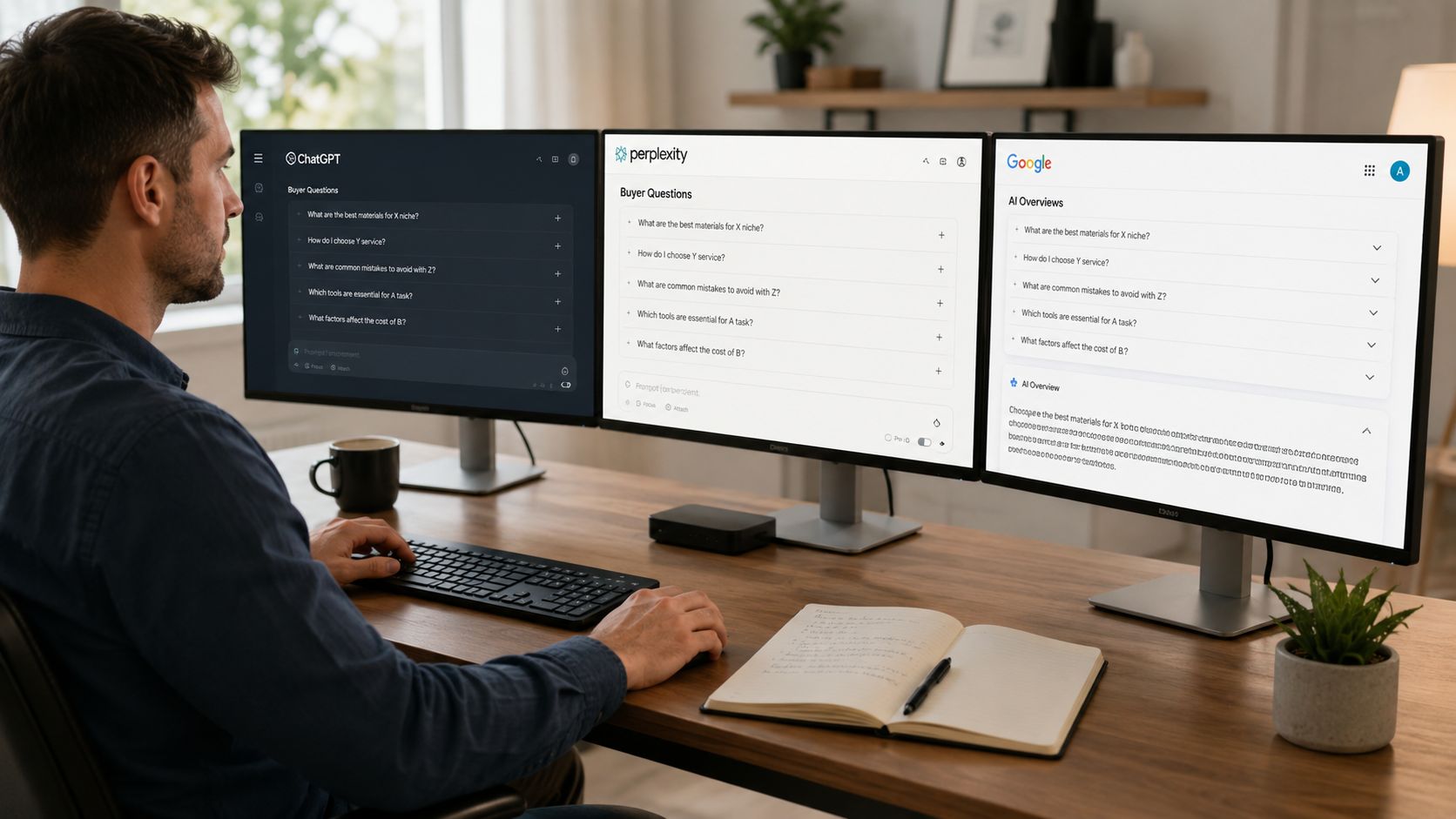
Run the same normalized prompts across ChatGPT, Perplexity, Google AI Overviews, and Claude. Use cleared sessions, consistent location settings, and identical wording wherever possible. One answer is an observation, not market truth. Repeated runs create a usable panel for separating retrieval noise from a persistent visibility gap.
A worked probe workflow
Suppose four prompts produce three different vendor lists. ChatGPT may cite a vendor homepage and a trade article, Perplexity may surface a Reddit discussion and a directory, while Google AI Overviews may draw from service pages absent from the other answers. That divergence is useful. Visibility is engine-specific, shaped by the sources each system retrieves and trusts. In a low-volume market, one well-structured service page or credible third-party reference can outweigh dozens of thin posts if it directly answers a recurring buyer question.
Capture the full answer, not only a screenshot of the opening paragraph. Log every cited URL, vendor order, descriptive language, inferred location, and run date. A shared spreadsheet or database should record the prompt version, engine, browser or session conditions, answer text, cited domains, and reviewer notes.
Two common measurement failures
Prompt drift can invalidate a comparison. If one week's question asks for “top suppliers” and the next asks for “reliable regional service companies,” the apparent change may reflect wording rather than visibility. Keep a locked prompt version, and only introduce a revised wording as a separate test.
Locale leakage creates another problem. A model may infer a country from browser settings, account history, or language, then return vendors outside the intended market. Keep location explicit, record it, and rerun anomalous results before treating them as a trend.
The 2026 measurement framework using 602 controlled prompts logged 21,143 valid search-layer citations across ChatGPT, Google AI Overview/Gemini, and Perplexity. Its findings indicate that Perplexity and Google cite more sources on average, while ChatGPT cites fewer sources but can show higher average citation influence among fetched pages. For niche teams, source quality and answer inclusion provide a better operating signal than raw mention counts.
Where Are Your Citation Gaps Against Named Competitors?
A citation gap is a missing source relationship, not a content deficit. Build a matrix comparing your brand with three to five named competitors across the buyer prompts already tested. Extract every cited URL from each answer, then classify each source by its role in the decision.
Useful categories include:
- Standards and research: Standards bodies, peer-reviewed journals, technical institutions
- Trade authority: Industry associations, trade publications, conference sites
- Reference ecosystems: Wikipedia, Wikidata, directories, G2, Product Hunt
- Community evidence: Reddit threads, LinkedIn posts, specialist forums
- Commercial sources: Vendor pages, comparison articles, affiliate listicles
Source type changes the meaning of a citation. A standards-body page defining a specification should carry more weight than a generic listicle when the buyer is checking compliance. A customer discussion may better address implementation concerns, while a product directory can help an engine resolve category membership.
Worked example in industrial vacuum metallurgy
Assume three competitors repeatedly receive the same two trade-publication citations for prompts about industrial vacuum metallurgy. Publishing another technical article may produce little change if buyers are asking about a specific ASTM specification and none of the answers cite the relevant standards body.
The actionable gap is an authoritative reference connecting the company's capability to that technical requirement. Create a verifiable standards explanation, publish an expert-authored service page that matches it, and pursue appropriate access to the relevant source ecosystem. Explain the relationship precisely, without implying an endorsement that does not exist.
A coverage score helps rank opportunities. Assign each prompt a presence score, each source a quality tier, and each competitor a slot count. The resulting view shows whether the strongest opportunity is an owned page, an association profile, a standards reference, or a community discussion. One well-structured service page or credible third-party reference can matter more than a large set of thin posts when the buyer questions are narrow.
| Source Type | Your Brand | Competitor A | Competitor B | Competitor C |
|---|---|---|---|---|
| Standards body | Missing | Missing | Missing | Missing |
| Trade publication | Present once | Present repeatedly | Present repeatedly | Present repeatedly |
| Vendor service page | Present | Present | Present | Present |
| Specialist directory | Missing | Present | Present | Missing |
| Community discussion | Unclear | Present | Missing | Present |
Illustrative example for the vacuum-metallurgy scenario above, not measured competitive data.
The GetIntel citation gap framework treats this source-level comparison as a distinct workflow from a conventional backlink audit. The objective is not to collect links in the abstract. It is to identify the domains and references that appear in actual buyer-facing answers, then connect each gap to a plausible source relationship.
Prioritize source ecosystems with three filters: relevance to the prompt, authority for the claim, and realistic access. A source that appears repeatedly, directly supports the buyer's question, and accepts credible contributions should come first. A prestigious page with no editorial activity or legitimate contribution path should not consume the quarter. Assess the ecosystem before assigning a content or outreach task.
Which Fix Lever Suits Each Gap?
The observed gap should determine the fix. Schema cannot repair weak authority, a larger publishing queue cannot resolve entity confusion, and outreach is wasted when the target source has no credible path for updates. In low-volume B2B categories, one accurate page or third-party reference can influence several buyer questions, so the choice of lever carries more weight than the amount of content shipped.
Match the lever to the evidence
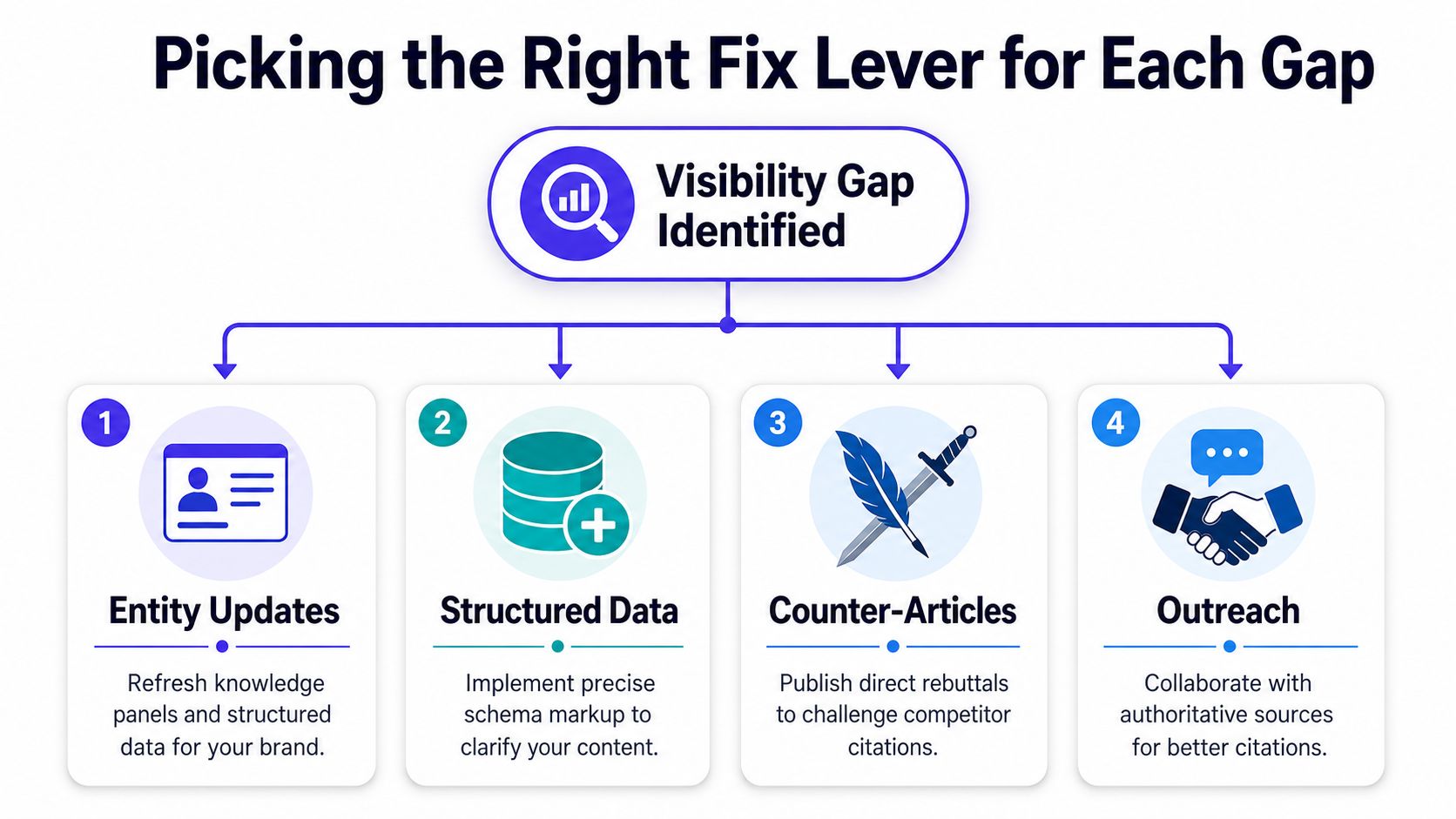
Entity and knowledge-base updates suit brands that answer engines cannot distinguish reliably. Overlapping names, inconsistent locations, or missing specialty information point to organization profiles, directory records, and Wikidata relationships as the first workstream. These updates clarify identity. They do not create authority on their own.
Structured data fits a useful page whose type, author, organization, product, or service relationship remains unclear to machines. Mark up information the page visibly supports, then check whether the page is indexed and eligible for ordinary search visibility. Schema describes evidence. It does not replace editorial quality or independent references.
Counter-articles address a cited competitor page that gives a thin, inaccurate, or incomplete answer. Answer the same buyer question, explain the technical distinction, name the author, and cite suitable supporting material. The purpose is to reduce a decision risk, not to publish a negative comparison for its own sake.
Outreach makes sense when a trade publication, association page, or specialist directory controls a valuable citation path. Offer a technical explanation, correction, useful contribution, or independently verifiable resource. Promotional claims without supporting evidence give editors little reason to participate.
The fastest lever is the one that fixes the observed gap, not the one your team already knows how to ship.
Use this decision sequence:
- Is the brand difficult to identify? Clarify the entity and align first-party profiles.
- Is the page relevant but ambiguous to machines? Add accurate structured data and make the visible relationships clearer.
- Is a competitor cited for a weak answer? Publish a direct, evidence-led counter-article.
- Does a third-party source dominate the answer? Pursue editorial outreach or a legitimate profile.
- Is the target source stale or inaccessible? Choose a stronger source ecosystem rather than forcing the relationship.
Avoid fixed turnaround promises and guaranteed lift. AI answers vary by engine, prompt, locale, retrieval state, and source freshness. Treat an authority target as weak when its editor has not updated it in years. Treat proposed schema as suspect when no visible page content supports the property. Reject counter-articles that repeat the competitor's framing without adding evidence.
Schema, Entities, and llms.txt in Thin-Footprint Niches
Schema is not a visibility button. In a thin B2B niche, its practical value is clearer machine interpretation of a page that already answers a buyer's question. One page that identifies the organization, service, author, product, geography, and relationships can contribute more than a hundred loosely connected posts, provided the page is useful and supported by credible references.
Entity clarity matters for the same reason. A claimed Wikidata item with accurate identifiers and sameAs relationships can help distinguish a specialized supplier from similarly named organizations. Markup does not create authority. It gives search systems cleaner facts about an entity that already exists across the web.
What structured data can and cannot do
A controlled Ahrefs study of 1,885 pages found no meaningful uplift in AI citations after schema markup was added. For Google AI Overviews, treated pages showed a 4.6% relative decline versus matched controls, according to Search Engine Journal's coverage of the schema test. The result makes one point clear: schema alone cannot substitute for relevance, evidence, or source authority.
Pages still need to be indexed and eligible for ordinary search visibility. No special schema type guarantees inclusion. Ahrefs' own research on schema and AI citations supports using structured data as a supporting signal rather than a trigger.
Use JSON-LD, identify the organization and author, connect related entities with @id and sameAs, and validate every property against the rendered page. Each important claim in the markup should have a visible counterpart. Unsupported or hidden claims in markup make interpretation less reliable, so alignment between what's marked up and what's visibly on the page matters more than the markup itself.
llms.txt serves a narrower purpose. Use it as a navigational file containing canonical URLs and a plain-English company summary. It cannot repair inaccessible pages, weak proof, or inconsistent identity signals. The llms.txt generator helps determine what belongs in the file and what should remain in the site's visible information architecture, and does llms.txt work covers what the file does and does not change.
Ship Organization, Person, Product, Service, WebSite, and relevant BreadcrumbList markup where the page supports them. Then maintain reference profiles, keep entity relationships consistent, and treat llms.txt as an index, not an AI citation strategy.
Tracking Impact and Shipping the Next Round of Fixes
Thin niches create noisy weekly results. A changed answer may reflect a different prompt interpretation, model response, locale, or source set rather than a real visibility gain. Record the same fields for every probe: citation presence, cited domain, citation position, vendor position, sentiment or framing, prompt wording, engine, locale, date, and change since the previous run.
Run the same buyer prompts on a consistent schedule across ChatGPT, Perplexity, Gemini, Google AI Overviews, and Claude. GetIntel is one option for teams that need daily topic-level scoring, Share of Voice, Average Citation Rank, live-interface answer capture, competitor comparisons, and source-level gap reporting across these engines. A spreadsheet or another monitoring platform works too, provided the prompt set, sampling conditions, and scoring method remain stable.
A 30-60-90 day cadence
First 30 days, establish the baseline. Freeze the prompt set, capture the current answers, classify cited domains, and label each gap by severity. For a niche such as industrial filtration or specialist compliance software, identify which questions matter commercially before changing the site. A single authoritative reference may influence more answers than a large batch of thin articles.
By 60 days, evaluate shipped fixes. Rerun the exact prompts, inspect the answer text, and compare source inclusion rather than counting brand mentions alone. A movement is more credible when it appears across repeated runs, affects the intended buyer-question family, and matches the source or entity change that was shipped.
By 90 days, graduate or kill. Keep a change that improves the target gap without causing entity confusion, unsupported claims, or negative framing. Stop an experiment when controlled reruns show no meaningful movement and the citation ecosystem remains unchanged. Prioritize the next work by citation-gap severity and commercial relevance, not by the loudest internal opinion.
Use this weekly sheet as the minimum record:
| Buyer Prompt | Engine | Date | Cited URL(s) | Citation Position | Sentiment / Framing | Delta vs Prior Week | Owner |
|---|---|---|---|---|---|---|---|
| Specific service question | ChatGPT | Recorded date | Full cited URLs | Answer order | Positive, neutral, or negative context | New, lost, or unchanged | Responsible person |
| Comparison question | Perplexity | Recorded date | Full cited URLs | Answer order | Descriptive framing | New, lost, or unchanged | Responsible person |
| Standards question | Gemini or Google AI Overview | Recorded date | Full cited URLs | Answer order | Technical framing | New, lost, or unchanged | Responsible person |
| Alternative question | Claude | Recorded date | Full cited URLs | Answer order | Recommendation context | New, lost, or unchanged | Responsible person |
Keep a separate post-fix retro with five fields: hypothesis, shipped change, expected source or entity effect, measured delta, and next action. This record connects a buyer question to a page, reference source, or entity correction, instead of treating screenshots as proof of progress.
The broader market evidence supports measurement at this level. The citation-rate variation by vertical documented earlier in this piece (Travel and Hospitality prompts carrying citations about 23% of the time, Automotive around 20%, Professional Services under 4%) makes the same point directly: AI visibility varies by vertical in ways traditional SEO position alone doesn't predict, so a niche category can't assume its visibility mirrors its search-ranking performance. A niche B2B team applies the same principle with a smaller prompt set. The volume may be limited, while the questions still determine shortlist inclusion and sales conversations.
GetIntel helps teams monitor how ChatGPT, Claude, Perplexity, Gemini, and Google AI Overviews represent their brand, then connect missing citations to practical fixes such as entity updates, schema, counter-articles, and outreach workflows. Visit GetIntel to track buyer-prompt visibility and compare your cited sources against named competitors.